Parent questions
How do I revive Quran time when my child says it's boring?
Treat "boring" as feedback on the activity, not a verdict on the Quran. Ask, listen and adjust.
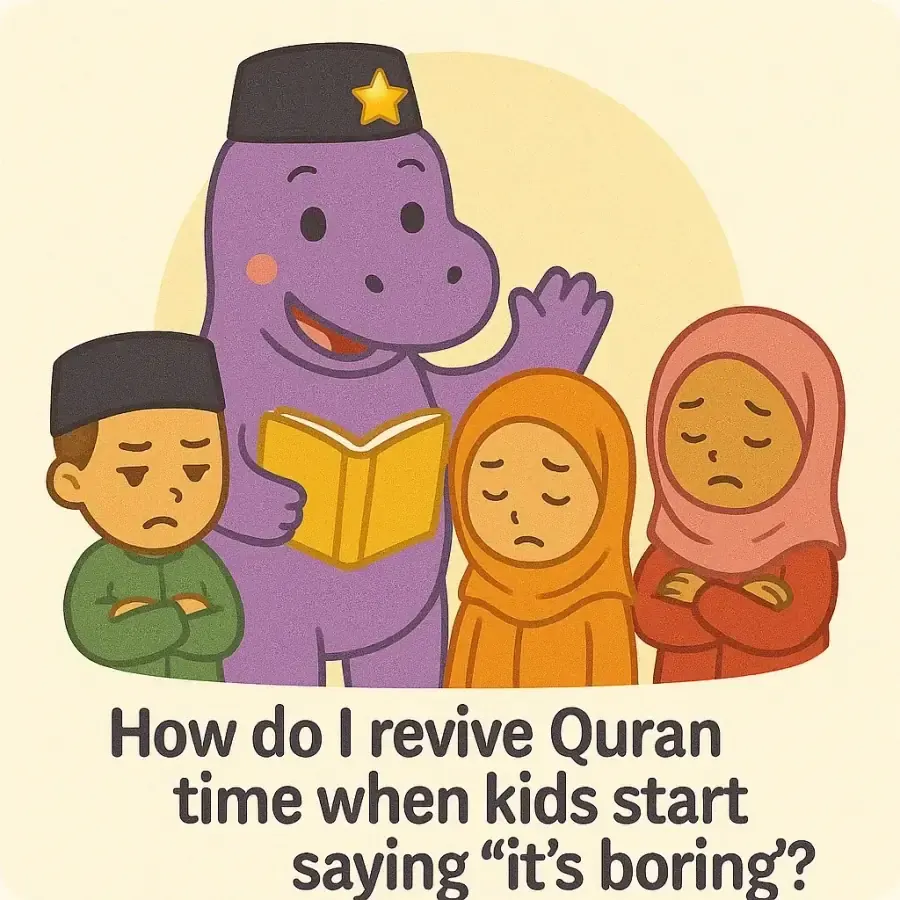
You have prepared a lovely Quran activity. You sit down, open the book, and your child says, "This is boring." It can sting.
Before reacting, ask what your child is really telling you. Are they tired? Is it too easy, or too hard? Are they embarrassed about mistakes? Do they not understand the language? Would they rather play after a long day at school?
Start with curiosity
Ask, "Which part feels boring?" Maybe they enjoy stories but dislike being interrupted every few seconds. Maybe the recitation is beyond their current stage. Maybe a correction once upset them. You don't have to agree that the Quran is boring to take their experience seriously.
Separate the Quran from the activity
The Quran has immense importance in a Muslim's life. A particular worksheet, app, pace or lesson plan can be improved. A child who says "I don't like this activity" isn't necessarily rejecting their faith. Don't put a heavy religious label on an ordinary complaint.
We ask for this feedback on purpose
After our Quran Reflection Journaling and Doodling workshops in 2017 and 2018, every participant filled in a short form with four boxes: Like (what they liked), Love (their aha moment), Lost (where they couldn't keep up) and Labs (what they want us to try next). The Lost and Labs boxes told us the most about what to change.
Doodling comes from the same thinking. A child who draws a verse has to think about it first. On her Surah Az-Zalzalah page, Hilwaa drew what happens in an earthquake and wrote what she would see, hear and feel. Under "feel" she wrote "100% scared". That is a child's honest reflection, and a good place to start a conversation.
A one-week reset
- Day 1, listen: ask your child to describe their least favourite part of Quran time, without interrupting.
- Day 2, simplify: choose a passage at their level and keep the session short.
- Day 3, offer a choice: "Would you like a story explanation or a drawing activity after we listen?"
- Day 4, make it real: talk about kindness, trustworthiness or gratitude in something that happened today.
- Day 5, review: ask what changed and what still feels hard.
Choice doesn't mean dropping structure. Children still need to learn correct recitation, attention and respect. If the difficulty continues, consider whether the level, the learning style or the relationship with the teacher needs adjusting. Sometimes a fresh teacher helps more than another app.
What not to say
Avoid threats such as "If you say that again, Allah will punish you." Instead, explain gently why Muslims treasure the Quran, and show what you treasure about it. Share a verse that comforts you, and why.
Try a question that changes the mood: "What do you wish you understood about the Quran?" You may hear, "Why do we read it in Arabic?" or "How do we know a story is real?" Now you have your next lesson.
For a younger child, read about rain or plants using a reliable explanation, then go and look at a real leaf. For an older child, explore the moral problem in a Quranic story. For a teenager, let them choose a theme to look into.
If you have been using pressure for months, rebuilding trust may take more than a week. Apologise when you have been unfair, keep your boundaries, and leave room for enjoyment.